Aussie Clothes Lines & Letterboxes
Clothesline
Selection Guide

WELCOME TO AUSSIE CLOTHESLINES
Aussie Clotheslines & Letterboxes are a local family business that has been supplying and installing Clotheslines throughout the Perth metropolitan area since 1994, operating from Two Rocks to Dawesville and the Perth Hills.
Over the years we have expanded our product range to include Commercial Multibanks and Domestic Letterboxes as well as Customised Letterbox Faceplates.
With our friendly and knowledgeable staff Aussie Clotheslines & Letterboxes
aims to make your decision an easy one when it comes to selecting the right
Clothesline or Letterbox to suit your needs, with personalised customer service to determine the right product for every budget and situation.
We can advise you of the best location to ensure optimum use of your garden
space, as well as providing installation, repairs, delivery, relocation,
removal, rewiring and servicing for all brands and models of Clothesline and Letterboxes. Delivery is typically within 7 days of the order.
At Aussie Clotheslines & Letterboxes we offer competitive rates and efficient service, and our workmanship is guaranteed for 12 months. We take pride in doing the job right the first time, being on time, completing the job at the agreed price and leaving the site clean and tidy.
Contact us to find out more about our products and services or our showroom in Joondalup.
Call us 1300 138 610
Email us info@aussieclotheslines.com.au
Visit us 5/133 Winton Road Joondalup WA 6027

THE TOP 7 THINGS TO CONSIDER WHEN BUYING A CLOTHESLINE
Clotheslines now come in a huge variety of sizes, styles and colours. With so many to choose from it can be difficult to know if you have made the right decision, especially as you will be using it on a daily basis for years to come, so will want to be confident in your choice.
Whether you have a tricky spot, large family, limited space, or are unsure if your surface is suitable, we can guide you to the best product to fit your space and meet your individual requirements.
This guide has been designed to assist you in the selection of the best clothesline to suit your needs, your space and your budget. It contains all the information about the factors you will need to consider when buying a new clothesline.
THE TOP 7 THINGS TO CONSIDER WHEN BUYING A CLOTHESLINE
-
There is a clothesline to fit every situation and suit every budget.
Most clotheslines have a 10 year manufacturer’s warranty but will last 15 years or more. The higher the quality, the longer it will last.
Buying the best quality you can afford with ample line space to suit your individual situation, will save you money in the long term, and cause fewer headaches along the way. The question here.
-
How many people
are in your household? Does your laundry get washed frequently, or once a week?The answers to these questions will indicate the size of clothesline required.
Whatever the size of your
family or the frequency you wash, having ample hanging space is a must.As a general rule of thumb, a small family of 2 or 3 could probably manage with up to 20m of line space, while a medium size family of 4 would need between 20 and 36m of line space. A larger household would most likely require 36m or more of line
space.- Rotary Clotheslines have lots of line space, with between 32 to 56 m, but will take up more space in your yard.
• Retracting Clotheslines provide between 26 and 50 m of line space (depending on the distance they pull out
to) but this may mean you will see your washing on the line from several rooms
of the house – not the best of views!• Folding Frame Clotheslines come in a wide range of sizes and dimensions, providing from 7 to 48m of line space, or can be tailored to fit unusual spaces, so this may be the solution for you.
If a full-size line is not possible, another option is to have the main clothesline in one area, and an ancillary unit either in the garage or under the eaves for that extra hanging space when there is an
overflow of wet washing or the weather is not conducive to drying.It is generally best to go bigger if possible – better not to use all the lines sometimes, rather than wishing you had more lines most of the time. A word of caution though; while we recommend fitting the clothesline with the most line space that can comfortably fit into the space, be aware that some units may have the line space you need, but the lines are spaced closer together. This may allow you to fit the clothesline in a small drying area but compromise the drying time by restricting airflow between the clothes.
If you are not sure on the correct size clothesline for your area, it may be worthwhile speaking with a clothesline expert on 1300 138 610 to discuss your available space and what size unit would work best for you. the answer to the question here.
-
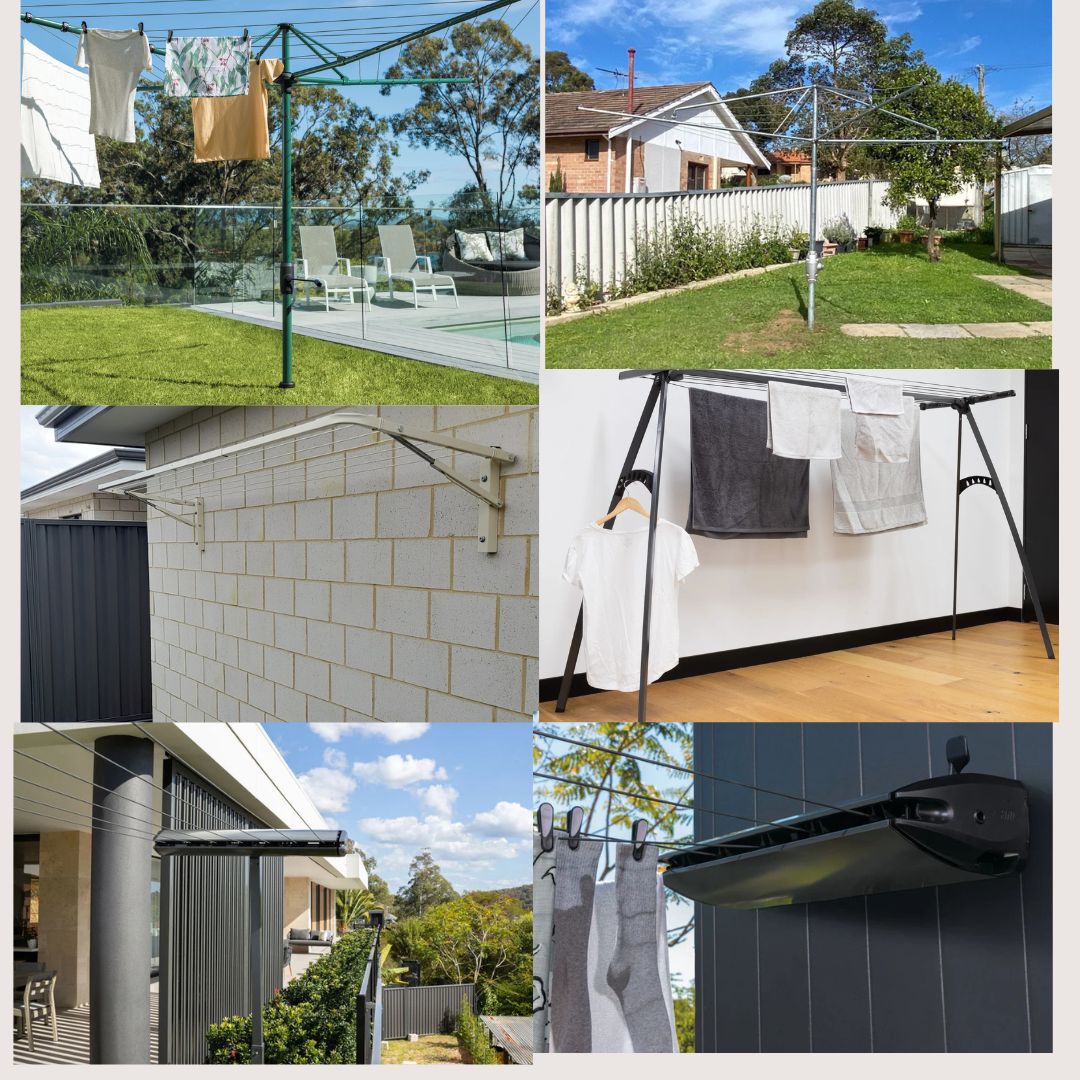
There are five different types of clothesline available. Select from the list below for an overview of each to help you make the right choice:
• Traditional Rotary Clothes Hoists
• Folding Rotary Clothes Hoist
Click here to see our Clothesline Comparison Charts.
-
A clothesline should ideally blend into its environment and not stand out like a sore thumb. To avoid making a feature
of it, we recommend matching
your clothesline to the background colour if possible, rather than the downpipes, roof or gutters.Colour swatches are provided on each product page, but if you are still unsure
we can advise you of the
closest colour match available. If you don’t see your favourite there, the City Living range has a choice of 50 colours so check out the City Living
Colour Chart for the full range available. -
There may be several spots you could choose from to have your new clothesline
installed, but the optimum position
depends on your family’s lifestyle habits and how you use your outdoor space.Would a clothesline in the middle of the backyard affect the amount of play area for the kids if they need space for a party, or a game of cricket or footy? Will the position of the clothesline impact on the view from the indoor
or outdoor entertainment areas?Proximity to laundry
Ideally, the clothesline should be situated close to the laundry area for easy access, and to avoid
trekking through or around the whole house lugging heavy baskets
of wet washing to get to and from the drying area. This may not seem possible on the face of it, but over the years we have had experience with just about every possible scenario you can think of, and there is always a solution.Weather
To save on expensive electricity and be kind to our environment, your dryer should only be used for emergencies.
This means though, that consideration needs to be given to an undercover drying area for use in wet weather, as well as protecting the washing from
harsh sunshine and bird droppings.Most wet weather in Perth comes
from the south-west, so a clothesline will be more protected on the east side of the house.Full sun can be quite harsh here and is not necessary for drying clothes. Airflow is actually the vital ingredient, and with our breezes and temperatures in the West, we have the best drying weather in Australia! So, when assessing the potential position
of your clothesline, air circulation is essential.To prevent the fading of clothes from too much exposure to the sun, place your clothesline in a breezy shaded area. If the line is in full sun, protect coloured clothing by pegging
on the line inside-out.Vegetation
Another factor to consider is over-hanging trees. Great for shade but inevitably also means bird-droppings
are more likely. Make sure there is sufficient clearance around the clothesline so that it can operate properly and the washing does not get snagged or caught on nearby branches or bushes.Boundary walls
It may be possible to install your clothesline onto a single brick parapet or adjoining boundary wall, but it is advisable to get your neighbour’s written permission beforehand.
Levels
If possible, the clothesline should be installed on an area of level ground so that reaching up to the clothesline can be achieved easily from any position. Ground- mounted folding frames will need both posts concreted into the ground to a specified depth, so going deeper at one end will mean a very low clothesline at the other.
The clothesline should always be set level, which may mean that there is a discrepancy between the level and height of the clothesline, and
the level and height of the fence behind.Heights
Rotary Hoists can be wound up and down with a handle to adjust the height to suit each user.
For other models that can’t be adjusted up and down, the optimum clothesline height is 1.8 metres up from the top of the pavers beneath. While a clothesline should be installed at a height that is comfortable to reach, there are often several people of different heights living on the property, that will need to be able to use the line or pass through the area. If the height is set for the person
most often using the line, ensure others will not be walking into it if they venture
out to the drying area.A clothesline may occasionally be set a brick course lower at 1.7m for the height- challenged; however, this could create a collision hazard for other laundry helpers.
Alternatively, it could be set one brick course above at 1.9m for taller
customers. Any higher could disadvantage others and make raising and lowering the line impossible by hitting the eaves.
Ground-mounted clotheslines can’t go any higher, as a sufficient portion of the
posts must be concreted below the surface to support the weight of the
clothesline, along with several loads of wet washing.Height can be an issue when installing onto a boundary fence, as there must be at least two brick courses above the height of the fixings to ensure adequate support for the tensile load of the
clothesline and washing.Rotary Clothes Hoists are designed
for outdoor use, but a clothesline cover will protect the inner lines from most
weather.Retracting Clotheslines can be installed either
outdoors or under
the pergola or veranda. The cabinet is inconspicuous
once the clothes are put away and lines retracted.Folding Frame Clotheslines can be installed either outside the house, undercover, or inside. Note that extra care is required to avoid water
pipes and electrical wiring when installing on single brick internal walls,
particularly in wet areas such as the laundry.Long, thin folding frames are useful down the narrow ‘dead’ side of the house, or inside the garage or
carport where cars need to share the space comfortably. All folding frame styles fold down flat when not in
use to maximise the area. It might be worth considering the possibility of two
clotheslines – one outside for fine weather and an ancillary line undercover for rainy days. If the clothesline must be outdoors,
a cover can be fitted to the frame for shelter, protection, or shade.Portable Clotheslines are ideal for use indoors or under the eaves for those wet winter days and can easily be moved into the sunshine for faster drying.
If you are not sure on where best to locate your clothesline, speak with a clothesline expert on 1300 138 610 to discuss your available space and what size clothesline would work best for you.
-
A suitable ground surface and correct installation technique is essential for stable and secure mounting. When planning to purchase a new clothesline, think about which method will be best for you.
Traditional Rotary Clothes Hoists are mounted into soil or grass and concreted into place.
Folding Rotary Hoists are installed into a ground socket, which is concreted into the ground.
Note: If a Rotary Hoist is to be
installed in the same position as the previous clothesline, we do not usually remove any concrete from the
ground, but instead cut the old clothesline off, below ground level and make it safe. This prevents
future sinking of ground level at the site over time, and helps maintain the integrity of the ground
surface. The fresh cement at the base of the new clothesline adheres to the old cement, providing a
secure footing for the new clothesline.Folding Frame Clotheslines can either be installed directly onto a brick wall or on to a pair of posts which are
concreted into the soil or grass.• Wall-mounted Folding Frame Clotheslines can be positioned across standard downpipes or water pipes running down the wall.
• Ground-mounted Folding Frame Clotheslines need space around the posts for concrete footings.
The posts are an optional extra which are engineered for this purpose and powder-coated to match the clothesline. Pavers may need to be lifted
to be able to insert the posts into the soil. Care is required so as not
to disturb reticulation and other service pipes below the ground.If there is no soil, grass or pavers for ground-mounting in the chosen area,
the posts may be attached to a poured concrete surface with either the addition of a pair of plated steel feet bolted to the ground or core drilling into the concrete. Extra costs would apply to either of these options.Retracting Clotheslines cabinets can either be installed onto a brick wall or onto a mount bar that is attached to a powder coated steel post which is concreted into the ground.
The polycord lines can then be pulled out to a receiving bracket on either another wall or post. The
lines should pull straight out from the cabinet and not on an angle.
Occasionally a sturdy patio post may be utilised.Mounting method options for Retracting Clotheslines, are:
Wall to Wall
Cabinet only
Wall to Post
Cabinet Post x 1
Post to Wall
Cabinet, Post x 1, and Mounting Bar x 1
Post to Post
Cabinet, Post x 2, and Mounting Bar x 1
Optional ground sockets can be installed in scenario 2 & 3, allowing for the post to be removed from the ground.
Ground sockets are not recommended for a ‘Post to Post’ installation as per scenario 4, as this can allow for too much movement in the posts resulting in extra slack in the lines. question here.
Surfaces for Wall Mounting
Best:
- Brick
- Concrete
Sometimes:
- Weatherboard, fibro or stud walls (unless internal support posts can be detected and utilised)
Mounting onto limestone walls is usually possible but will require deeper fixings and Chemset.Never:
- Hebel Brick Walls
- Colorbond sheds and/or fences
- timber, firbro, metal or asbestos fencing
Surfaces for Ground Mounting
Best:
- Soil
- Grass
Sometimes (Additional Cost and Equipment needed):
- Existing concrete
- Liquid limestone
- Exposed Aggregate
- Clay
- Gravel
IF YOU HAVE ANY QUESTIONS about your wall or ground surfaces or are unsure which installation method would be best for you, please call 1300 138 610 to discuss your specific needs with our clothesline experts today.
IMPORTANT:
• All installations require 300 - 500mm clearance from a HWS depending upon the age of the unit. All other hindrances must be cleared PRIOR to the installers arrival and is the responsibility of the customer. Failure to meet this deadline
will result in a call out charge for the Installers attendance and will require
another booking to complete the installation.• Not all clotheslines come with fixings
for wall-mounting included. Of those that do, some only come with basic
fixings. Our Installers use quality fixings
for all of our wall-mounted clotheslines to ensure they are properly secured.• We recommend all supporting posts
be cemented into the ground to ensure maximum stability.• Where stability is questionable due to soil variance or other factors, another mounting method should be considered.
-
Aussie Clotheslines and
Letterboxes stock a full range of clotheslines from Hills, Austral and City Living – all widely respected brands - in a wide range of sizes and colours.We sell direct to the public and can either give advice on DIY installation of your new
clothesline or arrange for one of our qualified professional installers to install it for you.
Should you decide you would like your clothesline installed by one of our Qualified Installers:1. Check that we install in your location.
2. Contact us with any queries relating to either the location of the installation or the surface it is going onto.
3. Place your order either online or over the phone by calling 1300 138 610.
Remember to include the job address if it differs from the invoice address.
4. Your order will be processed within 24 hours (Mon to Fri) and we will call you to arrange the installation date. Please make sure you provide the best phone number by which to contact you or leave a message.
As we keep a good quantity of all available products in stock, we can generally attend to your
instalIation within a week to ten days. It may take a little longer in busy times of the year. Extra time is required where customised products are ordered.5. The day before the installation, your allocated Installer will phone you to confirm details and give you a 1 - 2 hour time frame of when they will be at your
property the following day.Our Installers are efficient time managers and are reliably on schedule. On the off chance they have been caught in traffic or gotten ahead of themselves, they will contact you directly by phone to let you know what time they will be there.
If you suspect you may require extra services for your installation, contact us on
1300 138 610 to discuss your specific needs with our clothesline experts today.
-
General Information:
- Sometimes referred to as a Foldaline or Foldaway Hoist.
- Based on the traditional galvanised styled hoist but the arms can be folded up and the clothesline removed
from the ground socket to create more
yard space. - Suits a large backyard.
Advantages:
- Plenty of line space so can hold several loads of washing.
- Adjustable height. Colour options.
- Rotate for breeze drying clothes. Plenty of space between lines.
- Can be folded down and/or removed from the ground socket when not in use.
Disadvantages:
- Larger space needed for rotary clothes hoists.
- Lines can be slightly closer together than some other styles of clotheslines.
- Requires slightly more maintenance than the traditional hoist, mainly regular tensioning of the lines.
Mounting Options:
- Ground-mounted - the central column sits inside a socket or sleeve that is cemented into soil/lawn.
- Level ground preferred so that reaching up to the clothesline on all sides can be achieved without continually adjusting the height - too high on one side might mean low enough to walk into on the other.
- If the hoist is to be installed in the same position as the previous clothesline, we recommend cutting the bottom post off below ground level. This way the new hoist can be installed beside it with the fresh cement adhering to the old,
creating a super stable footing.
Materials:
- Made from quality galvanised and powder-coated steel, PVC
- polycord, plastic fixtures, fittings & gearing.
Dimensions:
- Head diametersrange between 3.2 and 4metres
Hanging Space:
- Varies between 32 and 56 metres of line length depending on the model.
Brands:
- Hills
- Austral
Clearance Required:
At least 1 metre clearance
is recommended around the head diameter allowing clearance for free movement of the rotary hoist so it can operate properly and washing does not get snagged or caught on branches, bushes, fences or gutters -
General Information:
- Sometimes referred to as a Hills Supa Hoist, Austral Super Hoist, or the
Hills Heritage Hoist. - The traditional style of Galvanised
Rotary Hoist. - Regarded as an Australian icon since 1945 and still seen in many back yards
today. - Suits a large backyard.
Advantages:
- Strong, sturdy and durable so have a long life span.
- Require very little maintenance - suitable for rental properties. Plenty
of line space so can hold several loads of washing. - Adjustable height.
- Rotate for breeze drying clothes.
- Larger spaces between lines and therefore have the quickest clothes drying time.
- Wire lines, not polycord, so no sagging.
Disadvantages:
- Cemented in the ground and cannot be folded down or removed.
- More expensive than most other clothesline styles.
- Take up a reasonably large amount of lawn area or entertaining space.
Not as attractive as the powdercoated styles.
- More difficult than other styles to install.
Mounting Options:
- Ground-mounted - the central column is concreted into soil/lawn.
- Level ground preferred so that reaching up to the clothesline can be achieved on all sides without adjusting the height - too high on one side might mean low enough to walk into on the other.
- If the hoist is to be installed in the same position as the previous clothesline, we recommend cutting the bottom post off below ground level. This way the new hoist can be installed beside it with the fresh cement adhering to the old,
creating a super stable footing.
Materials:
- Galvanised steel
- Galvanised wire
- Aluminium Fixtures
Dimensions:
- Head diameters of between 4 and 5 metres.
Hanging Space: - Varies between 40 and 60 metres of line length depending on the model
Brands:
- Hills
- Austral
Clearance Required:
- At least 1 metre clearance
is recommended around the head diameter to allowing clearance for free movement of rotary hoist so it can operate properly and washing does not get snagged or caught
on branches, bushes, fences or gutters.
- Sometimes referred to as a Hills Supa Hoist, Austral Super Hoist, or the
-
General Information:
- Sometimes referred to as a Paraline, Supafold or Fold Down clothesline.
- A fold-down rectangular steel outer frame with the polycord lines running parallel to the front bar.
- Many different sizes and configurations available - we can tailor on site!
- Suits narrow spaces or smaller blocks where a rotary hoist is not an option.
Advantages:
- Optional Leg kit for ground-mounting if not enough useful wall space available.
- Wide range of colours available.
- Wide range of sizes and shapes to suit most requirements or can be modified to custom fit.
- Longer models take any size bed sheets.
- Smaller or narrower models suit small backyards, garages, carports, courtyards and balconies.
- Can utilise space in tight areas
such as narrow spaces between a house and fence, and side access ways, so the washing is hidden from view. - Can be folded down when not in use and generally less obtrusive than rotary
clotheslines. - More cost effective than most other
styles. - Can be used as an indoor clothesline, as a secondary line for excess washing or undercover for winter drying.
- Lengths can be tailored custom for you
Disadvantages:
- Less hanging space than the rotary clothes hoists.
- Washing hung on internal lines,
may on occasion come in contact with nearby walls or fences. - Lines on some models are closer together; therefore drying time can be longer.
- Stationary, so longer drying time than rotary hoists.
Mounting Options:
- Wall mount or ground mount.
- Can be wall-mounted directly onto brick or masonry walls or posts mounted into the ground (not on wooden or colorbond fencing).
- Can be mounted across/over standard downpipes or water pipes.
- Level ground preferred so not too low at one end and too high at the other, and so both posts are in the ground sufficiently to support the weight of the unit and wet washing.
- Can be ground-mounted onto two posts and cemented into the ground.
- Usually installed so that front bar is
approximately 1.8 metres up from the pavers or lawn beneath.
Materials:
- Made of quality steel,then galvanised and powdercoated.
Dimensions:
- Widths varyfrom 0.52 to 3.6 metres,and depths from 0.60 to 1.5metres.
- Lengths can be tailored custom for you
Hanging Space:
- Varies from 7 to 39.5m of line length
depending on the model.
Brands:
- Austral
- City Living
- Hills
- Sunbreeze
Clearance Required:
- Allow 100mm clearance on either side of the clothesline and 350mm clearance from the front bar to allow room to lift and lower the line or to get past when fully loaded with clothes.
- Must be more than 500mm from a Hot Water Unit and ideally keep clear of any other obstructions such as air-conditioning units, gates, external doors, bushes and branches.
- Most Folding Frames can be modified to fit any space or requirement - there is always a solution!
-
General Information:
- Sometimes referred to as a Clothes Airer.
- Lightweight portable clothesline can be easily moved as needed.
- Used for winter drying, a secondary drying option or for small spaces. Different sizes to suit varying
requirements.
Features:
- Hills models are designed with holes on each end for extra coathanger hanging space.
- Suits balconies, garages or under the eaves for wet weather.
Advantages:
- Can be folded easily and put away when not in use.
- Can store flat and hung against a wall or behind a door (door hook included with Hills models). Great for apartments.
- Excellent for hanging
overflow of washing. - Lightweight but sturdy. Can be moved easily.
- Easy reach height – suits elderly and children. Undercover or full sun as required.
Disadvantages:
- Lines are relatively close together resulting in longer drying times than other styles of clothesline.
- Limited line space compared to other
clothesline alternatives. May need to
be put away in strong winds. - May need to be put away in strong winds.
-
General Information:
- Sometimes referred to as an Extendaline, Slimline or Retractaway clothesline.
- The lines are housed in a cabinet that is mounted to either a wall or a post
- The lines of polycord can be extended and lines attach to receiving bracket mounted
on another post or wall - the receiving bracket comes included with each clothesline cabinet. - If the cabinet is to be post-mounted, a mount bar will be needed to attach it to (optional extra).
- Suits narrow areas
- Optional ground socket is available to
enable posts to be removed if needed. - Minimum extension 2 metres.
- Maximum extension between 6.5 to 10 metres depending on the model.
Advantages:
- The lines can be retracted and stored away inside the cabinet when not in use.
- Unobtrusive and takes up very little room when lines are retracted. Large
amount of hanging space when fully extended. - Can be mounted outside, or under patios or verandas, in garages or on balconies for undercover drying.
- Can utilise space in tight and narrow
areas. - Lines stay clean when retracted away inside the unit. There are 4, 5, 6, and 7 line models available.
Disadvantage:
- Some sagging is inevitable over longer distances, especially with heavy items, e.g. blankets.
- Stationary, so longer drying time than
rotary hoists. Limited colour choice
available. - Use of ground socket/s may cause extra ‘give’ in the line and create greater sagging, especially with Post to Post mounting scenario.
Mounting Options:
- Wall to Wall
- Wall to Post
- Post to Post.
Materials:
- Cabinet, posts and mount bars are made from quality steel, then galvanised and powder coated.
Dimensions:
- Widths varyfrom 0.58m to 0.8m and extension lengths from 2 to8 10 metres.
Hanging Space
- Up to 26, 40 or 50 metres, depending on the model and the distance extended out to.
Brands:
- Austral
- Hills
- Sunbreeze
Clearance required:
- Allow 100mm of wall either side of cabinet.
- Can not be mounted within 500mm of a Hot Water Unit.
Clothesline Options